
2026 Mitsubishi Outlander PHEV: How Does the Hybrid Work?
2026 Mitsubishi Outlander PHEV: How Does the Hybrid Work?
Posted on April 13, 2026
Hybrid systems have evolved significantly, especially in vehicles designed to balance everyday practicality with improved efficiency and reduced emissions. The new Mitsubishi Outlander PHEV represents a mature implementation of plug-in hybrid technology, combining electric propulsion with a gasoline engine to prioritize smooth operation, adaptability, and energy efficiency.
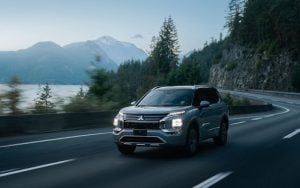
2026 Grey Mitsubishi Outlander PHEV
Unlike conventional hybrids, a plug-in hybrid system allows the vehicle to operate as a short-range electric vehicle while still retaining the flexibility of a combustion engine for longer trips. In the Outlander PHEV, this concept is executed through a dual-motor architecture and a sophisticated control system that continuously determines the most efficient way to deliver power.
2026 Mitsubishi Outlander Hybrid System Architecture
The Outlander PHEV uses a dual-motor plug-in hybrid system that differs from traditional hybrid designs. Instead of relying primarily on the engine, the system is electrically driven in many situations.
The main components include:
- Gasoline internal combustion engine
- Front electric motor
- Rear electric motor
- High-voltage lithium-ion battery
- Power electronics (inverter and converter)
- Hybrid control unit
This configuration allows the vehicle to operate in multiple modes, adapting to speed, load, and battery charge.
Internal Combustion Engine
Engine Role
The gasoline engine in the Outlander PHEV is not always the primary source of propulsion. Instead, it plays a flexible role depending on driving conditions.
Functions
- Generates electricity for the motors (series mode)
- Assists with propulsion at higher speeds (parallel mode)
- Supports battery charging when needed
Efficiency Focus
The engine is optimized to operate within efficient ranges, reducing unnecessary fuel consumption.
Dual Electric Motor System
Front Motor
Function
The front electric motor drives the front wheels and works in coordination with the engine and battery.
Characteristics
- Provides primary propulsion in electric mode
- Delivers smooth and immediate torque
- Assists during acceleration
Rear Motor
Function
The rear motor powers the rear wheels independently.
Benefits
- Enables electric all-wheel drive
- Improves traction and stability
- Allows precise torque distribution
No Mechanical Link
Unlike traditional all-wheel-drive systems, there is no driveshaft connecting the front and rear axles. Instead, the system uses electronic coordination between motors.
High-Voltage Battery System
Battery Design
The Outlander PHEV uses a lithium-ion battery pack designed for high energy density and repeated charging cycles.
Placement
The battery is integrated into the vehicle floor structure to:
- Lower the centre of gravity
- Improve handling stability
- Preserve interior space
Capacity and Use
The battery stores energy for:
- Electric-only driving
- Hybrid operation
- Regenerative braking
Charging Methods
External Charging
As a plug-in hybrid, the battery can be charged using an external power source.
Charging Characteristics
- AC charging through standard connectors
- Charging time varies depending on the power supply
Regenerative Braking
During deceleration, the system captures kinetic energy and converts it into electrical energy.
Process
- Electric motors act as generators
- Energy is stored in the battery
Benefit
Improves overall efficiency and reduces energy waste.
Driving Modes Explained
Electric Vehicle (EV) Mode
Operation
The vehicle is powered solely by the electric motors.
Characteristics
- Zero fuel consumption
- Quiet operation
- Ideal for urban driving
Series Hybrid Mode
Operation
The gasoline engine generates electricity, which powers the electric motors.
Key Feature
The engine does not directly drive the wheels in this mode.
Use Case
- Moderate speeds
- When battery charge is low
Parallel Hybrid Mode
Operation
The gasoline engine directly drives the wheels while electric motors assist.
Use Case
- Higher speeds
- Sustained highway driving
Regenerative Mode
Operation
Energy is recovered during braking and deceleration.
Adjustable Levels
Drivers may be able to adjust the regeneration intensity, which affects how strongly the vehicle slows when lifting off the accelerator.
Power Electronics and Energy Flow
Inverter
Converts direct current (DC) from the battery into alternating current (AC) for the electric motors.
Converter
Steps down high voltage to power standard vehicle systems.
Energy Flow Management
The system continuously directs energy between:
- Battery
- Electric motors
- Gasoline engine
This ensures efficient operation under all conditions.
Hybrid Control Unit
Central Coordination
The hybrid control unit is the brain of the system.
Inputs
- Vehicle speed
- Driver acceleration and braking
- Battery state of charge
- Road conditions
Outputs
- Determines driving mode
- Controls power distribution
- Manages charging cycles
This automation allows seamless transitions between modes without driver intervention.
All-Wheel Drive Through Electrification
Super All-Wheel Control (S-AWC)
The Outlander PHEV uses an advanced all-wheel-drive system that relies on electric motors.
Features
- Independent control of front and rear torque
- Real-time adjustments based on traction
- Integration with stability control systems
Advantages
- Improved grip on slippery surfaces
- Enhanced cornering stability
- Better control in varying terrain
Thermal Management Systems
Battery Cooling
The battery operates within a controlled temperature range to maintain efficiency and lifespan.
Cooling Method
- Liquid or air-based thermal management systems
Motor and Electronics Cooling
Electric motors and power electronics generate heat and require cooling to maintain performance.
Engine Cooling
The gasoline engine uses a conventional liquid cooling system.
Performance Characteristics
Instant Torque
Electric motors provide immediate torque, improving acceleration response.
Smooth Operation
The absence of gear shifts in electric mode enhances driving comfort.
Balanced Power Delivery
The combination of engine and motors ensures consistent performance across different speeds.
Efficiency Benefits
Reduced Fuel Consumption
Electric driving reduces reliance on gasoline, particularly in urban environments.
Energy Recovery
Regenerative braking captures energy that would otherwise be lost.
Optimized Engine Use
The engine operates only when necessary, improving overall efficiency.
Maintenance Considerations
Engine Maintenance
Standard maintenance applies to the gasoline engine.
Electric Components
Electric motors and power electronics are designed for durability and minimal maintenance.
Battery Longevity
The battery is engineered for long-term use, supported by thermal management and controlled charging.
Real-World Driving Scenarios
Urban Driving
- Predominantly electric operation
- Frequent use of regenerative braking
Highway Driving
- Engine provides sustained power
- Hybrid system supports efficiency
Mixed Driving
- Continuous switching between modes
- Balanced energy use and performance
Engineering Philosophy
Electrification First Approach
The system prioritizes electric driving whenever possible.
Flexibility
Multiple operating modes ensure adaptability across different conditions.
Integration
All components work together as a unified system.
2026 Mitsubishi Outlander PHEV FAQ
What type of hybrid system does the 2026 Mitsubishi Outlander PHEV use?
- It uses a plug-in hybrid system with a gasoline engine, dual electric motors, and a rechargeable battery.
Can the vehicle run entirely on electricity?
- Yes, it can operate in electric-only mode for shorter distances depending on battery charge.
How does the system switch between modes?
- A hybrid control unit automatically selects the most efficient mode based on speed, load, and battery level.
Does the Outlander PHEV have all-wheel drive?
- Yes, it uses dual electric motors to provide electric all-wheel drive without a mechanical connection.
How is the battery charged?
- The battery can be charged externally and through regenerative braking during driving.
*Disclaimer: Content contained in this post is for informational purposes only and may include features and options from US or internacional models. Please contact the dealership for more information or to confirm vehicle, feature availability.*